Manisha
Premnath
-
Doctoral Research-
|
|
"Shape shifter" cells:
What makes cells change morphology?
Can we keep them from changing shape?
HIGHLIGHTS:
- Certain
cells show striking and interesting changes in morphology (shape and form)
under different environmental conditions. Such changes in morphology are
often associated with important changes in cellular processes, cell function
and cell behavior. For example, it has been observed several pathogenic
fungi exhibit their pathogenicity only in certain morphological states. On
the other hand, morphogenesis in multicellular organisms is central to the
development of tissues and organs. In my PhD thesis, I used a fungus, B. poitrasii, to understand phenomena associated with the process of morphological change.
Change in morphology (shape and form) of cells
- The case of yeast (spherical) to mycelium (filamentous) transition in B. poitrasii -
|
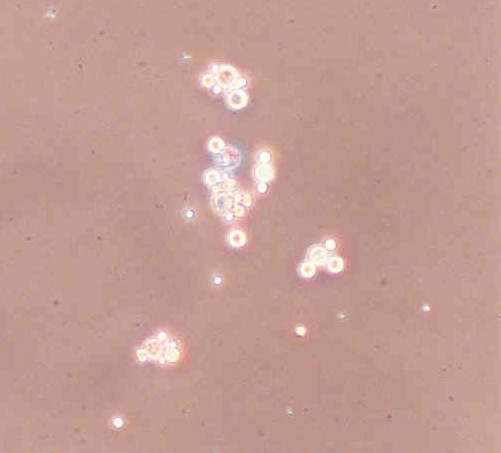
Yeast
|
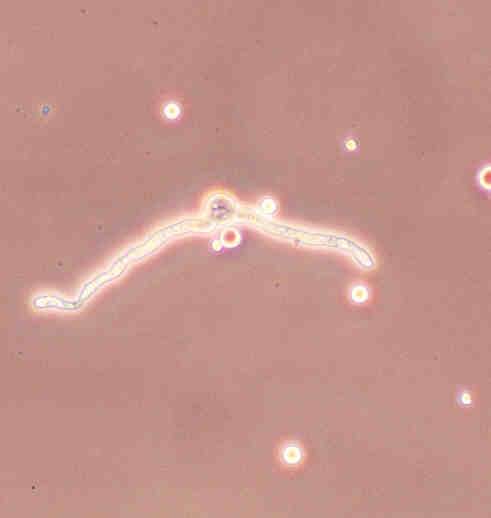 Transition
|
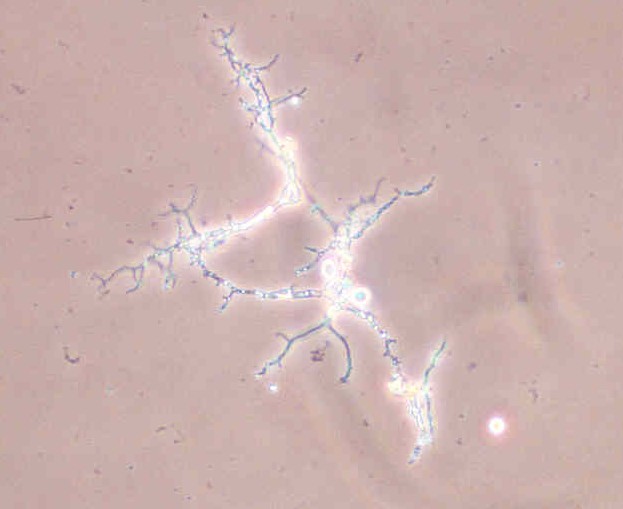
Mycelium
|
- The morphology of the cells is determined by environmental
conditions and their impact on critical cellular processes. For example,
in B. poitrasii, the morphology that cells prefer to exist in
depends strongly upon temperature and glucose concentrations. Corresponding
to morphology changes, one also observes significant changes in the processes
associated with cell wall metabolism - in particular, we established using
protoplast regeneration and biochemical studies that chitin metabolism influences morphological outcome
and that levels of chitin synthase (the enzyme that is involved in synthesis
of chitin) shows different levels in the different morphological forms.
- Often the basis of shape shifting lies in differential regulation of cellular pathways and genes expression. For example, in B. poitrasii,
we discovered as many as 8 different chitin synthase genes which were differentially
regulated in yeast and mycelium forms and also during the transition from
one form to another.
Differential expression of chitin synthase genes in B. poitrasii
|

|
- If we can identify and understand the key cellular pathways
and genes whose differential regulation determines morphological outcome
in cells, then we should be able to develop methods to externally regulate
these cellular processes and genes and thus obtain desired morphologies while
discouraging undesirable morphologies (for example, pathogenic morphologies
of certain fungi like C. albicans). For example, our discovery that
chitin metabolism (in particular, the expression of chitin synthase genes)
influences morphological outcome, helped us identify suitable chemical agents
(inhibitors) in the presence of which fungal cells exhibited only one morphology
preferentially.
----------------------------------------------------------------------
"Role of cell wall in the dimorphism of Benjaminiella poitrasii"
by Manisha V. Chitnis
(Research Guide: Dr. Mukund Deshpande)
Department of Biotechnology, University of Pune, India
Defense:
7 January 2002; Awarded: 6 January 2003
Abstract of PhD Dissertation (MS Word)
|
|